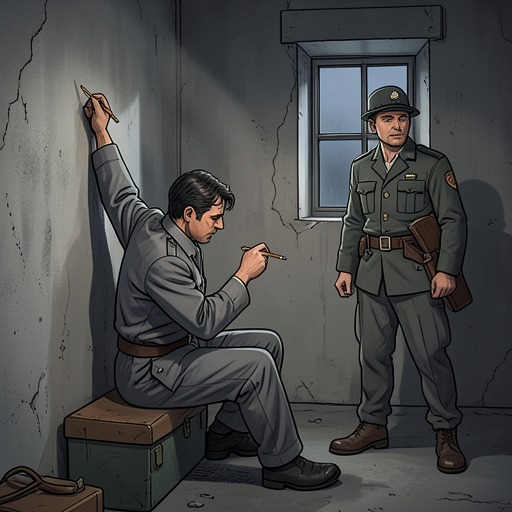
Modified Electric-Shock Interrogation Device
The SympathizerThe Modified Electric-Shock Interrogation Device is a makeshift apparatus used to keep The unnamed narrator awake during his interrogation in a reeducation camp. Its small, timed electrical shocks are presented as harmless stimulation rather than torture, yet their role in a system of sleeplessness and disorientation makes the device an instrument of coercion. Its improvised construction also concentrates a larger contradiction: technologies and techniques associated with foreign powers are adapted for a war and an interrogation conducted at home.
Construction and Operation
A doctor introduces the device after The unnamed narrator has been kept under bright lights and is struggling to remain awake. The apparatus begins with a brown leather satchel that the narrator recognizes as a military field telephone. Instead of using the telephone’s hand crank at its original output, the doctor says he has modified the electrical output and connected it to a wristwatch. A black wire runs from the satchel to the narrator’s toe.
The wristwatch supplies the timing. As its second hand crosses twelve, a brief electrical spark travels through the wire and jolts the narrator. The doctor describes the interval as sixty seconds and instructs the others to move the clip among the narrator’s toes so that one spot will not be burned. The stated aim is not to inflict pain but to provide enough stimulus to prevent sleep. In operation, the device is simple: a field telephone supplies the electrical source, a wristwatch regulates the moment of contact, and a wire carries the pulse to the patient.
The apparatus’s modest output distinguishes it from the more violent electrical methods the narrator has previously seen. He recalls watching an interrogation in which a subject was made to spasm at the turn of a telephone crank, and remembers being relieved that he had not been asked to operate it. Now the device does not make him scream or thrash; its spark startles him. That difference is central to the doctor’s claim that the setup is harmless, but it does not make the device benign: the jolt interrupts rest precisely because the narrator is being forced to stay awake.
The Interrogation System Around It
The device is introduced as one element in a coordinated effort to keep the narrator conscious and make him examine his own mind. The doctor explains that a serum supplied by the Soviets is intended to compel truth, while the electrical apparatus is described as an American component. The Commandant and the commissar oversee the larger process, but the doctor supplies its clinical rationale: since the mind cannot be seen or touched, the patient must be kept awake until he can observe himself as if from a distance.
The apparatus works alongside the interrogation room’s lights, changes in routine, and the presence of several interrogators. The commissar refuses the narrator’s requests to turn off the lights. After the doctor and The Commandant leave, the commissar remains with him, and the shocks continue. The narrator recognizes the principles behind the procedure because he had studied the KUBARK Counterintelligence Interrogation manual as a pupil. He knows its emphasis on isolation, sensory deprivation, joint interrogators, penetration agents, and unpredictability. Knowledge of the method does not protect him from it: he can identify the procedure and still be subjected to its effects.
The interruptions extend beyond the wire. A guard reattaches it to one of the narrator’s fingers; later, another shock comes through a wire clipped to his ear. The narrator’s food is also forced on him at an irregular time, and the changing attendants and sensations make the schedule difficult to anticipate. These details show how the electrical device belongs to a broader practice, rather than operating as a self-contained machine. Its pulse is one repeated disturbance within an interrogation organized to prevent sleep and unsettle the subject’s sense of control.
The Device and the Return of Memory
Under the shocks and unrelenting lights, the narrator is asked what he has forgotten. At first, he cannot give a clear answer. Then he realizes that he remembers the forgotten event: it took place in a room the police called a movie theater when foreigners visited, but used for interrogations when they did not. The device does not itself reveal what happened there. Instead, it helps sustain the condition in which the commissar’s questions and the narrator’s returning memories continue.
The remembered room contains Claude, the crapulent major, three policemen, and a Communist Agent captured with a list she had tried to swallow. The narrator had watched her interrogation. In his account, the policemen sexually assault her while he remains an observer; he recalls having asked for time alone with her, and being told that the General wanted the names immediately. The device’s shocks and the questioning therefore coincide with the recovery of a memory of abuse and of the narrator’s own presence during it. His eventual confession reaches beyond a technical account of the room: it brings into view the violence he witnessed and his failure to stop it.
The passage also makes the apparatus part of a narrative about the limits of expertise. The narrator had learned the formal techniques in the manual, but he recalls that the methods used in the movie theater included practices not written there and whose origins Claude did not know. The apparatus is a legible, deliberately engineered instrument; the remembered violence exceeds the manual’s orderly categories. What the narrator can name as a procedure does not encompass everything done to prisoners, or settle his responsibility for what he saw.
Representation, Appropriation, and Significance
An earlier film-set episode offers a pointed contrast to the narrator’s later interrogation. During the staged torture of James Yoon’s character, Binh, a stunt performer is subjected to simulated water torture, with a breathing tube used to make the scene safe for filming. The performance demands that the extras act as Viet Cong interrogators, while the narrator’s later recollections concern actual coercion in the interrogation rooms. The device is not used in the film scene, but the juxtaposition sets manufactured spectacle against the narrator’s lived experience of torture and the forced recovery of what he witnessed.
The apparatus’s mixture of sources gives it further significance. The doctor identifies the serum as Soviet and the electrical component as American; the narrator also recognizes the field telephone as an object associated with familiar interrogation techniques. The commissar describes both superpowers as having tested techniques, weapons, and ideas on the country during the Cold War, while presenting the local interrogators’ use of those methods as appropriation. The device thus materializes a political irony: a supposedly local examination of the narrator’s mind is assembled from technologies and procedures attributed to competing foreign powers.
The doctor’s assurances are themselves part of the scene’s tension. He insists that the apparatus is not intended to cause pain, and its low-output pulse does not produce the spectacular convulsions the narrator remembers from another interrogation. But the narrator trembles and waits for each timed contact while being denied sleep. The device’s threat lies not in a single dramatic injury but in its place within a sustained process that makes the body answer to an imposed schedule. Its ticking interval offers a small, measurable unit of time inside an interrogation designed to make ordinary rest, routine, and memory unreliable.